Cross-Border Data Transfers Under DPDP Section 16 and EU GDPR Chapter V
Cross-border data transfer rules under DPDP Section 16 and GDPR Chapter V: restricted-country lists, Standard Contractual Clauses, and data residency.
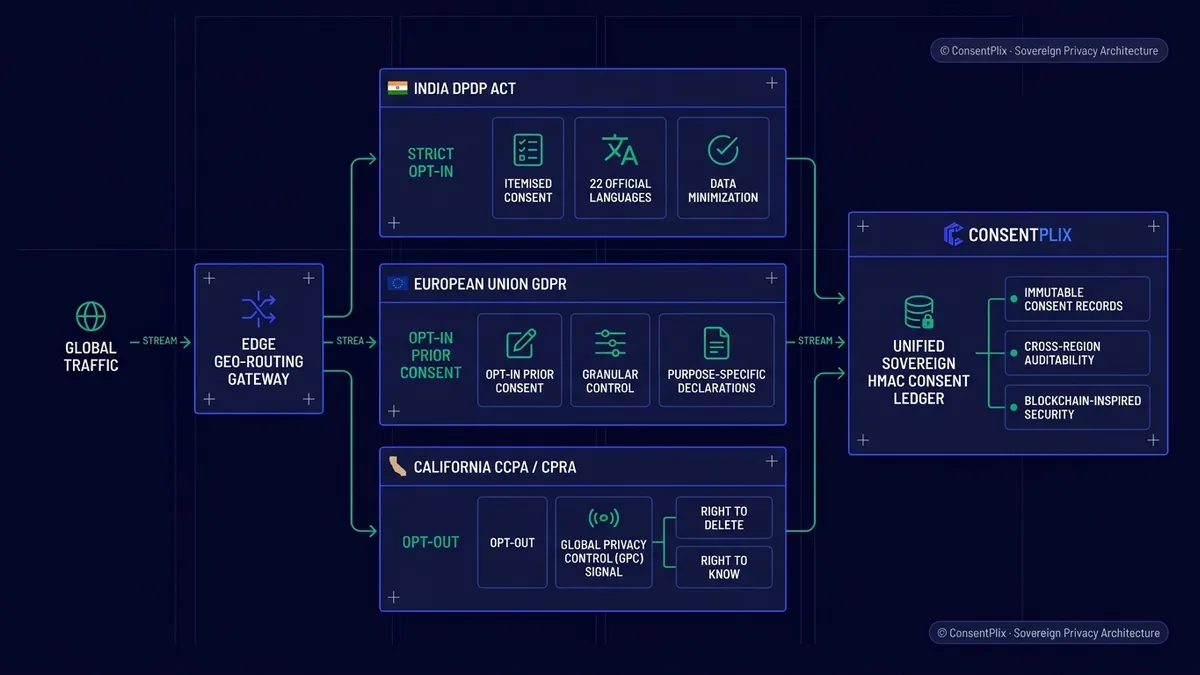
Comparative regulatory and technical analysis of cross-border data transfers under Section 16 of the DPDP Act 2023 and Chapter V of the EU GDPR. Explains India's negative-list (blacklisting) approach versus the EU adequacy and Standard Contractual Clauses (SCCs) framework. Outlines technical controls for managing cross-border telemetry, data localization mandates for critical sectors (RBI, IRDAI), and domestic consent ledger hosting in AWS Mumbai (ap-south-1).
The Global Data Transfer Dilemma for Tech Companies
Modern software businesses operate in an inherently borderless cloud environment. A digital platform based in Bengaluru or Mumbai frequently uses microservices, cloud analytics, customer support software, and data warehouses distributed across India, Europe, the United States, and Singapore.
However, as global data privacy regulations mature, transferring personal data across national borders is subject to increasingly stringent legal restrictions.
For organizations operating across India and international markets, compliance requires navigating two fundamentally different regulatory philosophies:
- India’s DPDP Act, 2023 (Section 16): Adopts a “negative list” (blacklisting) approach.
- The European Union’s GDPR (Chapter V): Adopts a “positive list” (adequacy & Standard Contractual Clauses) approach.
Understanding how these two regimes interact—and how to architect technical data boundaries—is essential to avoiding cross-border regulatory enforcement.
1. Section 16 of the DPDP Act: India’s Negative-List Framework
Under Section 16(1) of the DPDP Act:
“The Central Government may, by notification, restrict the transfer of personal data by a Data Fiduciary for processing to such country or territory outside India as may be so notified.”
Key Principles of Section 16:
- Default Freedom with Restrictions: Unlike earlier drafts of Indian data protection bills that proposed strict data localization for all sensitive personal data, Section 16 allows cross-border data transfers to most foreign jurisdictions by default, unless the Central Government places a specific country or territory on a restricted blacklist.
- Section 16(2) Sectoral Override: Section 16(2) explicitly preserves higher localization standards mandated by sectoral regulators:
“Nothing contained in this section shall restrict the applicability of any law for the time being in force in India that provides for a higher degree of protection for or restriction on transfer of personal data by a Data Fiduciary outside India.”
This means that while the DPDP Act allows general cloud transfers, strict domestic data residency mandates—such as the RBI Directive on Storage of Payment System Data (2018) requiring end-to-end payment data to be stored strictly in India—remain fully binding.
2. Comparing Section 16 with EU GDPR Chapter V
| Regulatory Variable | India DPDP Act 2023 (Section 16) | EU GDPR (Chapter V, Arts. 44–50) |
|---|---|---|
| Transfer Approach | Negative List: Allowed to all countries except those explicitly restricted by notification. | Positive List: Prohibited to all third countries unless deemed adequate (Art. 45) or safeguarded. |
| Transfer Safeguards | Sovereign government notification list. | Standard Contractual Clauses (SCCs), Binding Corporate Rules (BCRs), or explicit derogations (Art. 49). |
| Sectoral Carveouts | Section 16(2) preserves stricter sectoral localization (RBI payments, IRDAI insurance). | Sectoral laws must comply with overarching GDPR principles. |
| Enforcement Penalty | Breaches fall under general statutory cap up to ₹50 crore under The Schedule. | Up to €20 million or 4% of annual global turnover, whichever is higher (Art. 83(5)). |
3. Technical Architecture for Compliant Cross-Border Data Flows
To satisfy both Indian statutory requirements and international transfer standards, enterprise engineering teams must deploy geographically sovereign cloud architectures:
+------------------------------------------------------------------------+
|                     GLOBAL USER VISITS PLATFORM                        |
|                                |                                       |
|                                v                                       |
|                [Cloudflare Edge Geo-IP Routing]                        |
|                                |                                       |
|        +-----------------------+-----------------------+               |
|        | Indian IP Address                             | International |
|        v                                               v               |
|  [INDIA SOVEREIGN CLUSTER]               [GLOBAL MULTI-REGION CLUSTER] |
|  - AWS ap-south-1 (Mumbai)               - EU Frankfurt / US East      |
|  - Cryptographic Consent Receipts        - Standard Contractual Clauses|
|  - Complete Payment Data Localization    - GDPR Art. 6 Gating          |
|  - GRO Ticketing Escalations             - Standard Cookie Consent     |
+------------------------------------------------------------------------+
1. Sovereign Consent Ledger in AWS Mumbai (ap-south-1)
Under DPDP Section 8(5) and domestic regulatory expectations, storing consent audit trails and user authorization receipts within Indian borders ensures statutory sovereignty. ConsentPlix hosts all cryptographic keys and Merkle tree ledgers in AWS Mumbai, guaranteeing zero exposure to foreign subpoena laws (such as the US CLOUD Act).
2. Payload Scrubbing Before Cross-Border Analytics
When transmitting user telemetry to global analytics tools (Google Analytics, Mixpanel, Amplitude):
- Edge workers scrub high-risk identifiers (IP addresses, physical addresses, Indian national identifiers).
- Pseudonymous tokens replace user email addresses, ensuring that even if data transits foreign servers, it cannot be reverse-engineered without the private key stored in AWS Mumbai.
3. Automated SCC and DPA Generation
For international SaaS companies serving Indian clients, enterprise procurement requires signing Data Processing Agreements (DPAs) incorporating Standard Contractual Clauses and DPDP Act indemnities. ConsentPlix provides pre-signed, audit-ready DPA templates aligning with both DPDP and GDPR requirements.
Summary: Harmonizing Global Privacy Architecture
Operating cross-border does not require maintaining separate, disjointed applications for every jurisdiction:
- Utilize edge Geo-IP routing to deliver localized consent notices (DPDP 22 languages for India, GDPR Art. 6 controls for Europe).
- Anchor cryptographic audit trails domestically in AWS Mumbai (
ap-south-1). - Respect sectoral localization overrides (RBI KYC & Payments) while allowing compliant global cloud analytics.
To learn how ConsentPlix provides sovereign multi-region privacy infrastructure, explore our Global Cloud SaaS Solutions or schedule a consultation with our engineering team today.
Ajay Thanki
Co-Founder & Head of Privacy EngineeringWorks on Merkle audit proofs, tamper-evident data pipelines, and cross-regulation compliance for banking, fintech and enterprise teams.
Continue exploring sovereign compliance engineering.

Ready to deploy provable consent infrastructure?
Deploy in minutes with our sub-12KB SDK or schedule a customized technical consultation with our privacy engineering team.