Countdown to November 13, 2026: Consent Manager Registration Rules Explained
What the 13 November 2026 Consent Manager date under the DPDP Rules, 2025 means: technical standards, interoperability, and what Data Fiduciaries should do.
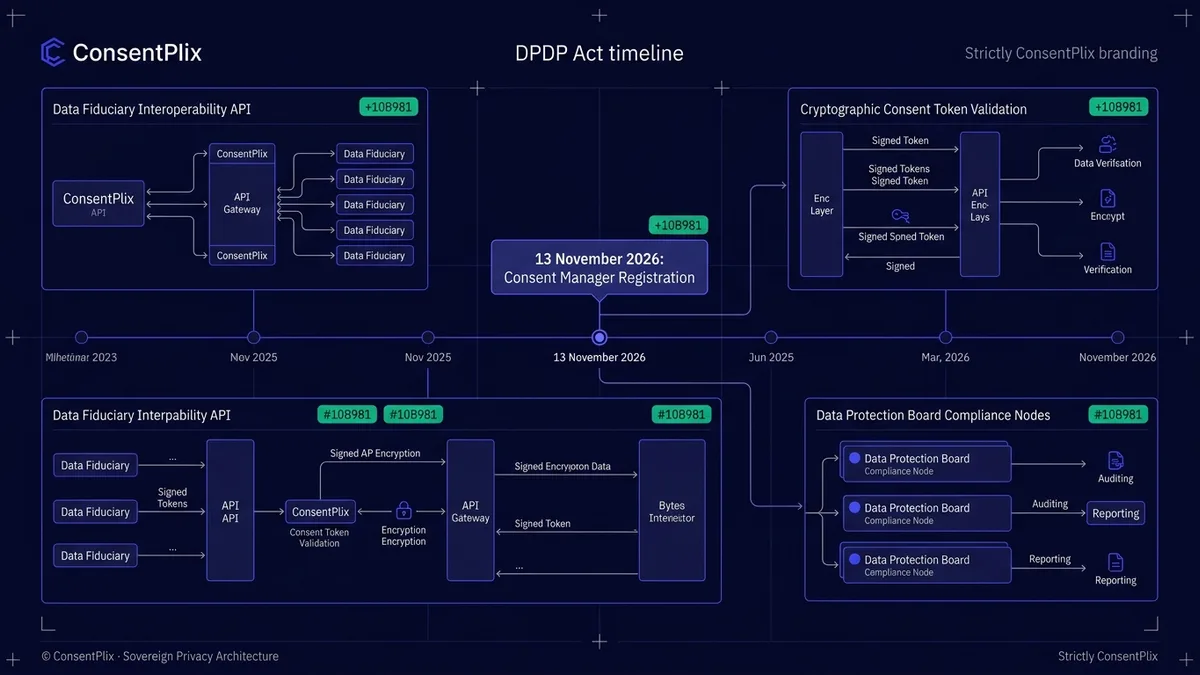
Comprehensive regulatory countdown and technical analysis of the November 13, 2026 enforcement date for Consent Manager registration under the DPDP Rules, 2025. Clarifies the phased rollout schedule: Board provisions taking effect November 13, 2025; Consent Manager registration opening November 13, 2026; and general enforcement beginning May 13, 2027. Explains the statutory difference between a Data Fiduciary's own Consent Management Platform (CMP) and registered Consent Managers under Section 6(7)–(9), interoperability APIs, and how businesses can prepare their systems ahead of the deadline.
Understanding the Phased Enforcement Timeline of the DPDP Act
As organizations across India prepare for compliance with the Digital Personal Data Protection (DPDP) Act, 2023, keeping track of regulatory deadlines is critical to avoiding compliance chaos.
Under the statutory framework established by the DPDP Rules, 2025 (G.S.R. 846(E), 13 November 2025), the Central Government structured enforcement into three distinct phases:
- 13 November 2025: Provisions establishing the Data Protection Board of India (DPBI), adjudication processes, and foundational administrative rules took effect.
- 13 November 2026: Provisions governing the registration, technical interoperability, and operational obligations of Consent Managers under Section 6(7)–(9) become mandatory.
- 13 May 2027: Full statutory enforcement and penalty adjudication under The Schedule become active across all Data Fiduciaries and processors.
With November 13, 2026 approaching on the horizon, technical and legal leaders must understand the precise requirements governing Consent Managers and how they interact with enterprise systems.
1. What is a Consent Manager Under the DPDP Act?
Section 6(7) of the DPDP Act defines a Consent Manager as:
“An entity registered with the Board, which acts as a single point of contact to enable a Data Principal to give, manage, review and withdraw her consent through an accessible, transparent and interoperable platform.”
CMP vs Consent Manager: Clarifying the Distinction
It is vital to distinguish between a Consent Management Platform (CMP) like ConsentPlix and a statutory Consent Manager:
- Consent Management Platform (CMP): The technical infrastructure deployed by an individual Data Fiduciary (business) on its own website or mobile app to present privacy notices, record consent choices, and gate tracking scripts.
- Registered Consent Manager: An independent, interoperable intermediary registered with the DPBI that acts on behalf of the citizen across multiple unaffiliated businesses, similar to an Account Aggregator in financial services.
Under Section 6(8), a Consent Manager is directly accountable to the Data Principal and acts on her behalf. Under Section 6(9), all Consent Managers must fulfill technical, operational, and interoperability standards prescribed by the Central Government.
2. Technical Interoperability Standards for November 13, 2026
When Consent Manager rules take effect on November 13, 2026, registered Consent Managers will interface with Data Fiduciaries via standardized open APIs.
+------------------------------------------------------------------------+
|                     DATA PRINCIPAL (Mobile Citizen App)                |
|  [Citizen Views Universal Dashboard of All Consents Across Fiduciaries]|
|  - Clicks "Revoke Analytics Consent for Acme Retail"                   |
+-----------------------------------|------------------------------------+
                                    |
                                    v
+------------------------------------------------------------------------+
|               REGISTERED CONSENT MANAGER (DPBI Licensed)               |
|  - Validates Citizen Digital Signature                                 |
|  - Issues Interoperable Consent Revocation Artifact (XML / JSON)       |
+-----------------------------------|------------------------------------+
                                    |
         Encrypted Interoperability Webhook Call to Fiduciary
                                    |
                                    v
+------------------------------------------------------------------------+
|               CONSENTPLIX SOVEREIGN GATEWAY (AWS Mumbai)               |
|  [Ingests Consent Manager Artifact]                                    |
|  - Verifies Digital Signature of Registered Consent Manager            |
|  - Updates Fiduciary Cryptographic Ledger                              |
|  - Triggers Downstream Erasure Pipelines Under Section 8(7)            |
+------------------------------------------------------------------------+
Essential Interoperability Requirements:
- Standardized Consent Artifacts: Consent and revocation instructions are encoded in machine-readable JSON/XML schemas containing purpose IDs, timestamp, and digital signatures.
- Mutual TLS (mTLS) Authentication: All API interactions between Consent Managers and Data Fiduciaries require mutual cryptographic certificate verification.
- Audit Chain Maintenance: Every interaction between a registered Consent Manager and a Data Fiduciary must be logged in an append-only ledger satisfying Section 6(10) evidentiary standards.
3. How Data Fiduciaries Should Prepare for November 2026
Even if your organization does not intend to become a registered Consent Manager, your systems must be capable of receiving and honoring instructions from registered Consent Managers.
Here is the three-step readiness roadmap:
Step 1: Implement Purpose-Based Cataloging
Under Section 6(1), consent must be unbundled and purpose-specific. If your current systems bundle all data processing into a single monolithic user agreement, external Consent Managers will be unable to parse or manage individual user choices. Catalog your data processing purposes into defined categories (core service, analytics, marketing, third-party sharing).
Step 2: Establish Inbound Interoperability Webhook Gateways
Ensure your backend architecture can ingest external revocation pings. ConsentPlix provides automated inbound webhook receivers that listen for standardized Consent Manager payloads, automatically translating them into internal database update events.
Step 3: Verify Data Residency in AWS Mumbai (ap-south-1)
Under MeitY technical guidelines, interoperability endpoints must operate within sovereign Indian data residency boundaries. Hosting your consent endpoints in AWS Mumbai ensures compliance with domestic data sovereignty rules.
Summary: Getting Ahead of the Statutory Timeline
The countdown to November 13, 2026 is an opportunity for forward-thinking engineering teams to establish scalable, future-proof compliance architecture:
- Understand the distinction between internal CMPs and registered Consent Managers.
- Build interoperable API gateways capable of ingesting external consent artifacts.
- Maintain immutable cryptographic ledgers anchored in AWS ap-south-1 (Mumbai).
To learn how ConsentPlix prepares your infrastructure for Consent Manager interoperability, explore our Consent Manager registration guide or schedule a technical briefing with our privacy engineering team today.
Amjad Rathod
Co-Founder & Chief ArchitectLead architect of the ConsentPlix consent ledger and sub-12KB client SDK. Works on DPDP Section 6 consent flows and high-throughput privacy engineering.
Continue exploring sovereign compliance engineering.

Ready to deploy provable consent infrastructure?
Deploy in minutes with our sub-12KB SDK or schedule a customized technical consultation with our privacy engineering team.