Dark Patterns in Cookie Banners: India's Rules and How to Fix Them
India's 2023 Dark Patterns Guidelines and the DPDP Act both apply to consent banners. See the patterns to avoid and how to build a banner that passes.
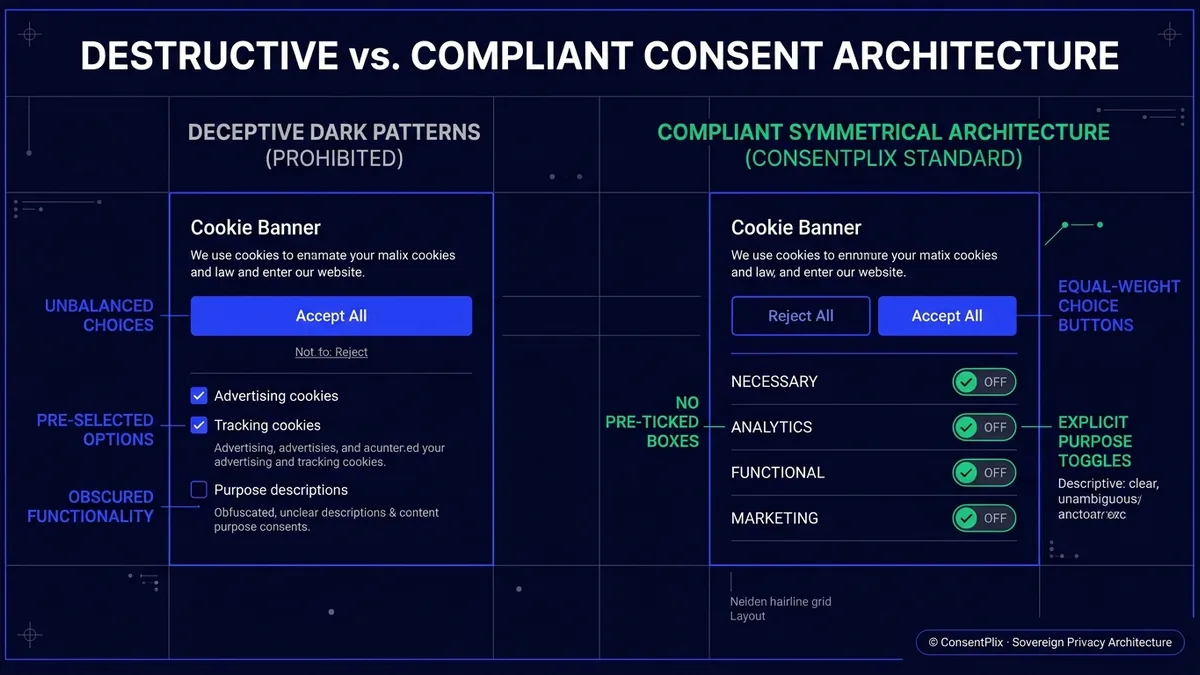
Two Indian laws shape how consent banners must look. The Guidelines for Prevention and Regulation of Dark Patterns, 2023, notified by the Central Consumer Protection Authority on 30 November 2023 under the Consumer Protection Act, 2019, list 13 banned dark patterns, including false urgency, confirm shaming, forced action, interface interference, nagging and trick questions. The DPDP Act 2023 requires consent to be free, specific, informed, unconditional and unambiguous with a clear affirmative action (Section 6(1)), and withdrawal to be as easy as giving consent (Section 6(4)). A compliant banner gives Accept and Reject equal weight, has no pre-ticked boxes, blocks trackers until consent, and offers withdrawal at any time.
The short answer
In India, a consent banner has to satisfy two sets of rules at once:
- The Guidelines for Prevention and Regulation of Dark Patterns, 2023, issued by the Central Consumer Protection Authority (CCPA) on 30 November 2023 under the Consumer Protection Act, 2019.
- The DPDP Act 2023, which says consent must be free, specific, informed, unconditional and unambiguous (Section 6(1)), and that withdrawing must be as easy as giving it (Section 6(4)).
A banner that tricks people into clicking “Accept” fails both.
The 13 dark patterns in India’s guidelines
The CCPA guidelines apply to all platforms offering goods or services in India, as well as advertisers and sellers. They list 13 specified dark patterns:
- False urgency
- Basket sneaking
- Confirm shaming
- Forced action
- Subscription trap
- Interface interference
- Bait and switch
- Drip pricing
- Disguised advertisement
- Nagging
- Trick question
- SaaS billing
- Rogue malwares
Five of these show up again and again in consent banners.
Five banner patterns to remove
Interface interference: a bright Accept and a hidden Reject
The most common problem. “Accept all” is a big coloured button while “Reject” is grey text or buried in a settings screen. This pushes the user towards one choice, which is the opposite of free consent under Section 6(1).
Fix: give Accept and Reject the same size, colour weight and position on the first screen.
Forced action: no consent, no access
Blocking the whole site until someone accepts marketing cookies forces a choice. Under the DPDP Act, consent must be unconditional, and you cannot make a service depend on consent to data it does not need.
Fix: let people use the site after rejecting non-essential cookies.
Confirm shaming: guilt-trip wording
“No thanks, I don’t care about a better experience” is confirm shaming.
Fix: use neutral labels such as “Accept” and “Reject”.
Nagging: asking again and again
Showing the banner on every page after someone has said no wears them down until they accept.
Fix: remember the choice, and only ask again when your purposes change.
Trick question: confusing wording
Double negatives (“Uncheck to not opt out”) or pre-ticked boxes make it unclear what the user agreed to. The DPDP Act requires a clear affirmative action, so a pre-ticked box is not consent.
Fix: every purpose starts unticked, in plain language.
A banner that passes: checklist
- Accept and Reject are equal on the first screen.
- No purpose is pre-ticked.
- Each purpose is listed separately, as Section 5 requires.
- Analytics and ad scripts stay blocked until consent. See consent before ads and tracking scripts.
- Users can read the notice in English or any of the 22 Eighth Schedule languages if they choose.
- A link or button to change or withdraw consent is always available.
- You keep proof of what each person saw and chose (Section 6(10)).
What happens if you get it wrong
Dark patterns are handled by the CCPA under consumer protection law. Consent failures under the DPDP Act fall under the Board’s general penalty cap of up to ₹50 crore in the Schedule. The ₹250 crore figure you may have seen applies only to failing reasonable security safeguards under Section 8(5). Estimate your exposure with the free penalty calculator.
Check your banner now
Run the free DPDP website scanner to see whether trackers fire before consent. ConsentPlix banners are built with equal choices, no pre-ticked boxes and one-click withdrawal by default. Try it free.
Dark patterns list from the CCPA Guidelines, 2023. DPDP references checked against Act No. 22 of 2023, as of October 2026.
Ajay Thanki
Co-Founder & Head of Privacy EngineeringWorks on Merkle audit proofs, tamper-evident data pipelines, and cross-regulation compliance for banking, fintech and enterprise teams.
Continue exploring sovereign compliance engineering.
Ready to deploy provable consent infrastructure?
Deploy in minutes with our sub-12KB SDK or schedule a customized technical consultation with our privacy engineering team.