Custom DPDP Compliance Engineering: How to Build Beyond Cookie Banners
Why off-the-shelf cookie widgets fail Indian statutory compliance. Learn how to engineer custom DPDP setups, server-side tag gating, and database audit sync.
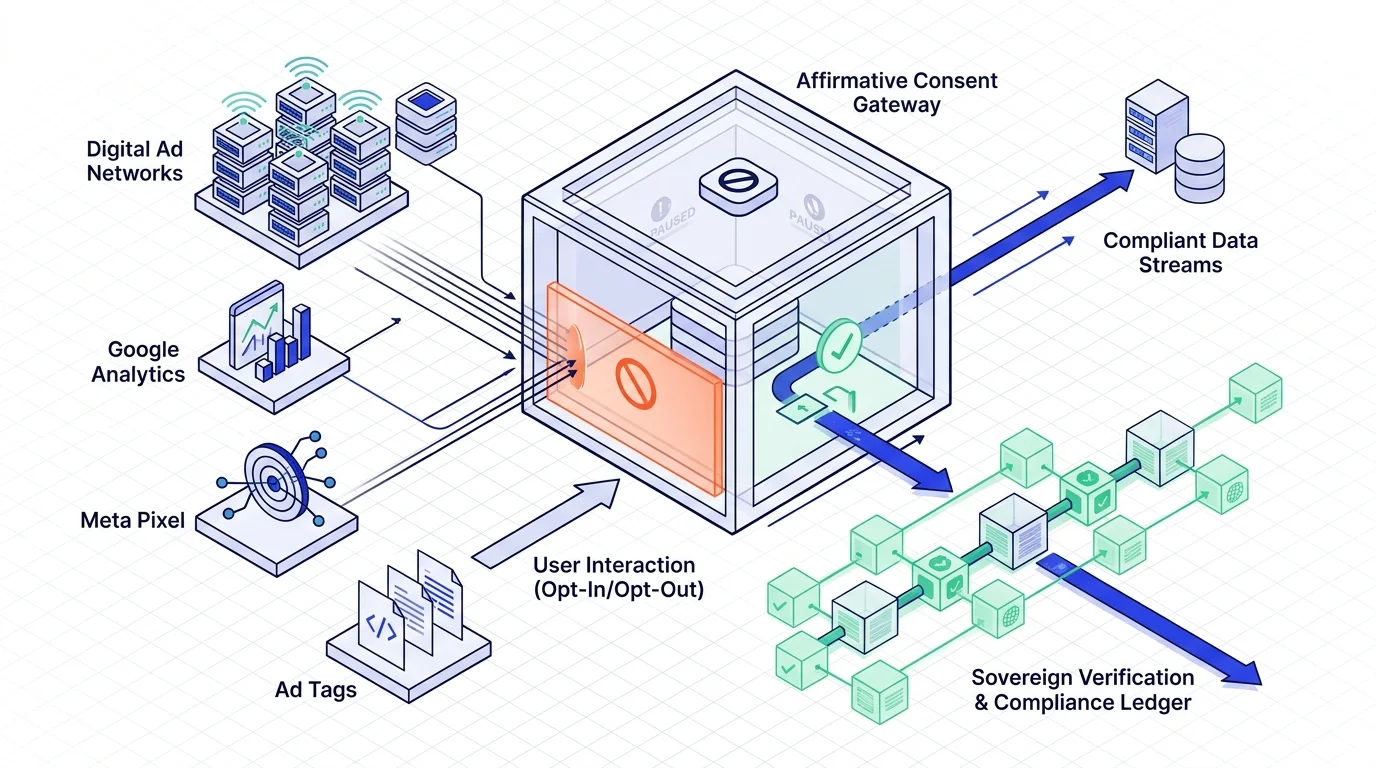
In-depth technical architecture guide for engineers building custom DPDP Act 2023 compliance systems beyond standard cookie banners. Analyzes why visual widgets leave companies exposed to statutory penalties up to ₹50 crore under the Schedule for consent and notice breaches. Details architectural implementation for zero-leakage server-side tag gating via Google Tag Manager and Cloudflare Edge Workers, cryptographic HMAC-SHA256 consent receipt storage in AWS Mumbai (ap-south-1), automated Section 8(7) database erasure webhook dispatchers, and custom mobile SDK integration for React Native and Flutter.
The Illusion of Front-End Cookie Banners Under the DPDP Act
Most development teams treat data privacy compliance as a purely cosmetic task: install a lightweight JavaScript banner, paste a script snippet into the HTML <head>, and assume the organization is fully compliant with India’s Digital Personal Data Protection (DPDP) Act, 2023.
This superficial approach fails under statutory scrutiny.
Under the DPDP Act and the DPDP Rules, 2025, regulatory enforcement targets the entire data processing lifecycle, not just the presence of a visual banner. When tracking pixels fire asynchronously prior to user consent, when consent decisions fail to propagate to backend databases, or when user erasure requests under Section 12 are trapped in manual spreadsheet queues, your organization faces severe statutory exposure.
Under The Schedule of the Act, consent and notice breaches carry general penalties capped at ₹50 crore, while failure to maintain reasonable security safeguards to prevent personal data breaches under Section 8(5) carries penalties up to ₹250 crore.
True compliance requires bespoke privacy engineering. Here is how to architect custom DPDP infrastructure that seals compliance gaps across your production codebases.
1. Zero-Leakage Pre-Consent Interception Architecture
Under Section 6(1) of the DPDP Act, personal data can only be processed for a lawful purpose for which the Data Principal has given clear, affirmative consent. If an ad network pixel, session recorder, or telemetry script captures an IP address, cookie identifier, or device fingerprint before the user interacts with the consent notice, a statutory breach has occurred.
+-------------------------------------------------------------------------+
|                  BROWSER / CLIENT TOUCHPOINT                            |
|  [User Visits Page] ---> [ConsentPlix SDK Intercepts DOM Execution]     |
|                                |                                        |
|        +-----------------------+-----------------------+                |
|        | Consent Granted                               | Consent Denied |
|        v                                               v                |
|  [Dispatch Unblocked Payload]              [Drop Tracking Telemetry]    |
+--------|-----------------------------------------------+----------------+
         |
         v
+-------------------------------------------------------------------------+
|                  EDGE COMPUTE (Cloudflare / sGTM)                       |
|  [Filter Payloads via Google Consent Mode v2 Consent Signals]           |
|                                |                                        |
|        +-----------------------+-----------------------+                |
|        v                                               v                |
|  [Meta CAPI / Google Analytics]            [Anonymized Pings Only]      |
+-------------------------------------------------------------------------+
Implementing Client-Side Script Interception
Off-the-shelf banners frequently fail because modern asynchronous scripts (async / defer) execute before the banner’s script evaluation finishes. Custom privacy engineering requires modifying the script injection mechanism:
<!-- Non-Compliant Implementation: Fires Immediately -->
<script async src="https://www.googletagmanager.com/gtag/js?id=G-XXXXX"></script>

<!-- Compliant Engineered Implementation: Type Gated -->
<script
  type="text/plain"
  data-consent-category="analytics"
  data-src="https://www.googletagmanager.com/gtag/js?id=G-XXXXX">
</script>
Our client SDK intercepts script execution by hijacking the dynamic DOM insertion API (document.createElement) and checking local cryptographic consent tokens before swapping type="text/plain" to type="javascript".
2. Server-Side Tag Gating via Cloudflare Workers & sGTM
Client-side blocking is vulnerable to browser extensions, script race conditions, and caching anomalies. For robust enterprise setups, our engineers implement server-side tag gating via Server-Side Google Tag Manager (sGTM) and edge compute workers.
In a custom server-side setup:
- Incoming HTTP requests pass through an edge worker (e.g., Cloudflare Workers or Fastly Edge).
- The worker inspects the
consentplix_receiptcookie containing the HMAC-SHA256 signature. - If analytics or marketing consent is absent, the edge worker scrubs outgoing conversion payloads (Meta Conversions API, TikTok Events API, Google Analytics Measurement Protocol) before sending them across the network.
- Ad-tech platforms receive zero pseudonymous identifiers, preventing unapproved third-party tracking at the network layer.
3. Cryptographic Proof of Consent for Section 6(10)
Section 6(10) of the DPDP Act introduces a critical legal mandate:
“Where a question arises in any proceeding as to whether consent was given by the Data Principal for the processing of their personal data, the burden of proof shall be on the Data Fiduciary.”
Traditional relational databases fail this test. If your engineering team stores consent as a simple boolean flag (has_consented = true) in a MySQL or PostgreSQL table, any database administrator or developer could theoretically mutate that record. In an investigation by the Data Protection Board of India (DPBI), mutable database rows do not provide tamper-evident proof.
The Cryptographic Receipt Structure
Custom privacy engineering replaces mutable flags with cryptographic receipts:
{
  "receipt_id": "c7f92b4e-9d21-4f18-a6d1-8b7c5e219034",
  "timestamp": "2026-10-22T08:14:22.104Z",
  "purposes": {
    "core_service": true,
    "analytics_telemetry": true,
    "marketing_personalization": false
  },
  "notice_version": "v2.4-dpdp",
  "language": "hi",
  "hmac_sha256": "8f3b219e4a8c17b5e82f10d9a6c4b2e8f17a93c4e2b8d1a5f6e9c2b4a7d8e1f0",
  "data_residency": "ap-south-1-mumbai"
}
Every consent choice is signed using an isolated secret key stored in AWS Key Management Service (KMS) located strictly in the ap-south-1 (Mumbai) region. Daily receipt hashes are rolled into Merkle trees, establishing an unalterable chain of custody.
4. Automated Database Erasure Pipelines Under Section 8(7)
Under Section 8(7) and Section 12, when a Data Principal withdraws consent or requests data erasure, the Data Fiduciary must erase personal data unless statutory retention is required by another law.
Manual compliance processes—where privacy teams email engineers Jira tickets to delete user rows across 15 databases—inevitably fail SLA deadlines and leave orphaned records in logs, backups, and CRM platforms.
Building Event-Driven Erasure Webhooks
Custom privacy engineering connects ConsentPlix webhook dispatchers directly to your backend microservices:
- User Action: The Data Principal clicks “Erase My Data” on your branded Data Principal Rights portal (
/rights). - Webhook Trigger: ConsentPlix issues a signed
dsr.erasure.requestedevent payload over HTTPS. - Queue Ingestion: Your backend API ingests the event into an asynchronous queue (Apache Kafka, AWS SQS, or RabbitMQ).
- Conflict-of-Law Audit: Worker services check whether statutory retention applies (e.g., RBI KYC norms or PMLA 2002 requiring 5-year transaction retention). If exempt, non-statutory marketing profiles are deleted, and a legally binding denial certificate is issued.
- Cascading Deletion: Workers execute targeted deletion queries across primary databases (Postgres, Mongo), data lakes (Snowflake, BigQuery), and downstream marketing platforms (CleverTap, Klaviyo).
- Signed Confirmation: The worker returns an execution proof hash to ConsentPlix, which automatically issues a digitally signed Certificate of Erasure to the Data Principal.
Summary: Engineering Your Path to Full DPDP Readiness
Achieving true compliance under India’s DPDP Act requires moving past superficial cookie banners into full-stack privacy architecture:
- Suppress tracking scripts at the edge and in the browser before affirmative consent.
- Replace mutable database booleans with HMAC-SHA256 cryptographic ledgers.
- Automate Section 8(7) erasure and Section 6(4) withdrawal across all customer databases.
- Maintain sovereign domestic data residency within AWS ap-south-1 (Mumbai).
If your team is looking to close compliance gaps, explore our dedicated Bespoke Privacy Engineering Services or schedule a technical scoping call to audit your stack today.
Amjad Rathod
Co-Founder & Chief ArchitectLead architect of the ConsentPlix consent ledger and sub-12KB client SDK. Works on DPDP Section 6 consent flows and high-throughput privacy engineering.
Continue exploring sovereign compliance engineering.
Ready to deploy provable consent infrastructure?
Deploy in minutes with our sub-12KB SDK or schedule a customized technical consultation with our privacy engineering team.