DPDP Section 12 Erasure vs RBI & PMLA Mandatory Retention: Resolving Statutory Conflicts
How fintechs, NBFCs, and banks resolve statutory conflicts between DPDP Section 12 data erasure rights and mandatory 5-year retention under PMLA and RBI KYC.
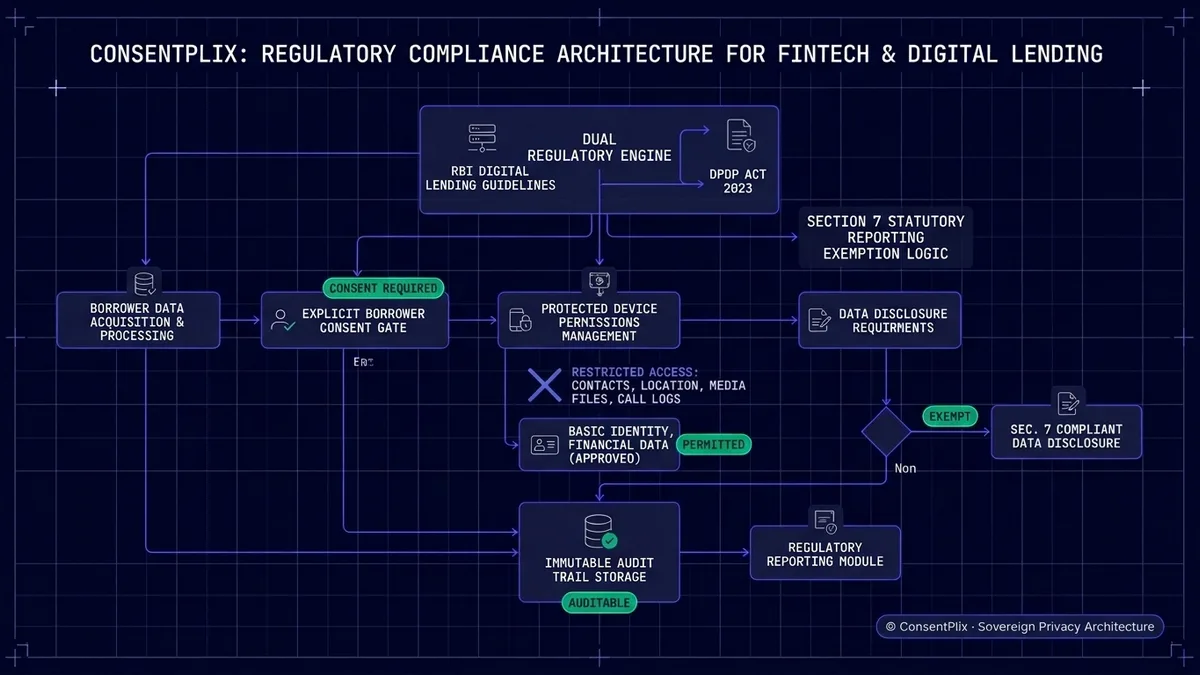
Comprehensive architectural analysis resolving the statutory conflict between Data Principal erasure rights under Section 12 of the DPDP Act 2023 and mandatory regulatory retention duties under PMLA 2002, RBI Master Directions, and the GST Act. Explains Section 17 exemptions and Section 8(7) retention limits. Outlines automated legal hold pipelines, cryptographic denial certificates with HMAC-SHA256 signatures, and bifurcation of regulatory data from marketing telemetry.
The Fintech Dilemma: Erasure Rights vs Mandatory Retention
For financial institutions, banks, non-banking financial companies (NBFCs), and Lending Service Providers (LSPs) operating in India, the rollout of the Digital Personal Data Protection (DPDP) Act, 2023 introduces a significant regulatory tension:
On one hand, Section 12(1)(b) grants Data Principals the statutory right to demand the erasure of their personal data once the purpose for processing is complete or when consent is withdrawn under Section 6(4).
On the other hand, Indian financial regulators enforce strict, non-negotiable retention mandates:
- Prevention of Money Laundering Act (PMLA), 2002: Section 12 requires reporting entities to maintain records of transactions and client identity documentation for at least 5 years after the business relationship has ended.
- RBI Master Direction on Know Your Customer (KYC): Mandates retaining customer identification data and account files for at least 5 years following account closure.
- Central Goods and Services Tax (CGST) Act, 2017: Section 36 requires books of account and tax invoices to be retained for up to 72 months (6 years).
If a fintech platform blindly honors a user’s erasure request and wipes their database records, they face severe regulatory penalties and license revocations from the Reserve Bank of India (RBI) or Financial Intelligence Unit (FIU-IND). Conversely, if the institution ignores the erasure request without statutory grounds, they face penalties under the DPDP Act up to ₹50 crore for consent and rights violations.
Here is the technical blueprint for resolving this statutory conflict.
1. Statutory Grounding: Why Regulatory Mandates Prevail
The DPDP Act specifically accounts for conflicts with sectoral laws through two vital statutory mechanisms:
Section 8(7): The Retention Caveat
Section 8(7) requires a Data Fiduciary to erase personal data upon purpose completion or consent withdrawal, “unless retention of such personal data is necessary for compliance with any law for the time being in force.”
Section 17(1)(b): Legal and Judicial Exemptions
Section 17(1)(b) explicitly provides that the provisions of Chapter II (Obligations of Data Fiduciary) and Chapter III (Rights and Duties of Data Principal) do not apply where processing is necessary for the enforcement of any legal right or claim.
Therefore, when a customer with an active or recently closed loan or bank account requests erasure, the financial institution is legally obligated to refuse deletion of regulated KYC, transaction, and tax records, while simultaneously halting all non-statutory processing (marketing, credit score tracking, behavioral profiling).
2. The Automated Conflict-of-Law Resolution Architecture
To protect financial institutions from both DPBI and RBI sanctions, our privacy engineering team implements a four-stage automated evaluation pipeline:
+-------------------------------------------------------------------------+
|                  CUSTOMER SUBMITS ERASURE REQUEST                       |
|           [User Triggers "Erase My Data" on /rights Portal]             |
|                                |                                        |
|                                v                                        |
|             [Conflict-of-Law Rules Engine Evaluation]                   |
|                                |                                        |
|        +-----------------------+-----------------------+                |
|        | Active Regulatory Duty                        | No Active Duty |
|        v                                               v                |
|  [BIFURCATED EXECUTION]                        [FULL ERASURE PIPELINE]  |
|  1. Seal KYC & Transaction Data                1. Full Database Deletion|
|     Under PMLA 5-Year Legal Hold                  Across All Clusters   |
|  2. Purge Marketing & Analytics Telemetry      2. Issue Certificate     |
|  3. Issue Cryptographic Denial Certificate        of Erasure            |
+-------------------------------------------------------------------------+
Stage 1: Identity & Relationship Verification
When an erasure request arrives, the system verifies the user’s identifier against core banking, loan origination (LOS), and ledger databases to determine account status:
- Is there an active loan, credit line, or open savings account?
- What was the official date of account closure or loan termination?
Stage 2: Statutory Timer Calculation
The engine evaluates the elapsed duration against statutory timers:
- If
account_closure_date + 5 years > current_date, a mandatory PMLA/RBI retention hold applies. - If
last_invoice_date + 6 years > current_date, a mandatory CGST tax retention hold applies.
Stage 3: Data Bifurcation (Regulated vs Non-Regulated)
Rather than a binary “delete all or reject all,” the system bifurcates the customer’s data into two distinct categories:
| Data Category | Statutory Classification | Action Taken |
|---|---|---|
| KYC Documents (PAN, Aadhaar Vault token, Passport) | Mandatory PMLA / RBI Retention | Sealed under Legal Hold; moved to cold, encrypted archive. |
| Transaction Logs & Repayment Schedules | Mandatory PMLA Section 12 | Sealed under Legal Hold; access restricted to audit personnel. |
| Invoices & GST Tax Filings | Mandatory CGST Section 36 | Sealed under Legal Hold until 72-month timer expires. |
| Marketing Audiences (CleverTap, Meta CAPI) | Discretionary Processing | Immediately Deleted; unlinked across ad networks. |
| Behavioral Telemetry & Session Recordings | Discretionary Processing | Immediately Deleted; purged from data lake. |
| Credit Bureau Pull Tokens (CICRA 2005) | Discretionary Processing | Revoked; all recurring bureau refresh jobs halted. |
3. Cryptographic Denial Certificates: Legal Defense for Section 12
Under the DPDP Rules, 2025, when a Data Fiduciary denies a Data Principal’s erasure request, it must provide a clear written explanation specifying the statutory justification.
ConsentPlix automates this workflow by issuing a digitally signed Section 12 Statutory Denial Certificate:
{
  "certificate_id": "denial_sec12_8a92b3c4",
  "request_timestamp": "2026-10-26T14:10:02Z",
  "data_principal_id": "usr_77182903",
  "determination": "PARTIAL_DENIAL_STATUTORY_HOLD",
  "statutory_grounds": [
    {
      "statute": "Prevention of Money Laundering Act, 2002 §12",
      "mandate": "Mandatory 5-year retention of KYC and transaction records post account closure",
      "hold_expiration": "2029-04-15T00:00:00Z"
    },
    {
      "statute": "Central Goods and Services Tax Act, 2017 §36",
      "mandate": "Mandatory 72-month retention of tax invoices",
      "hold_expiration": "2030-03-31T00:00:00Z"
    }
  ],
  "purged_categories": [
    "marketing_telemetry",
    "ad_network_identifiers",
    "behavioral_session_data"
  ],
  "hmac_sha256": "4b8e219a7f3c10d8a5e9b2c4e6f1a8d3e9c2b4a7d8e1f08f3b219e4a8c17b5e8",
  "data_residency": "ap-south-1-mumbai"
}
The Data Principal receives this certificate via their rights portal, satisfying the DPDP Act transparency requirement. In the event the user lodges a grievance with the Data Protection Board of India, the institution produces the certificate as conclusive proof of compliance with Section 8(7) and Section 17.
Summary: Building Robust Compliance for Regulated Fintech
Fintechs cannot rely on generic cookie tools to navigate financial compliance. True readiness requires:
- Automatic detection of active customer accounts and regulatory retention windows.
- Clear bifurcation of mandatory financial records from optional marketing telemetry.
- Cryptographic proof generation proving statutory justification before regulators.
To explore how ConsentPlix engineers bespoke conflict-of-law pipelines for banks, NBFCs, and fintechs, visit our Fintech & BFSI Solutions or schedule a technical consultation with our engineering team today.
Amjad Rathod
Co-Founder & Chief ArchitectLead architect of the ConsentPlix consent ledger and sub-12KB client SDK. Works on DPDP Section 6 consent flows and high-throughput privacy engineering.
Continue exploring sovereign compliance engineering.
Ready to deploy provable consent infrastructure?
Deploy in minutes with our sub-12KB SDK or schedule a customized technical consultation with our privacy engineering team.