Architecting DPDP Section 6(4) Consent Withdrawal Across Distributed Microservices
How to engineer real-time consent withdrawal under DPDP Section 6(4). Event-driven microservices, Kafka pipelines, and downstream marketing unlinking.
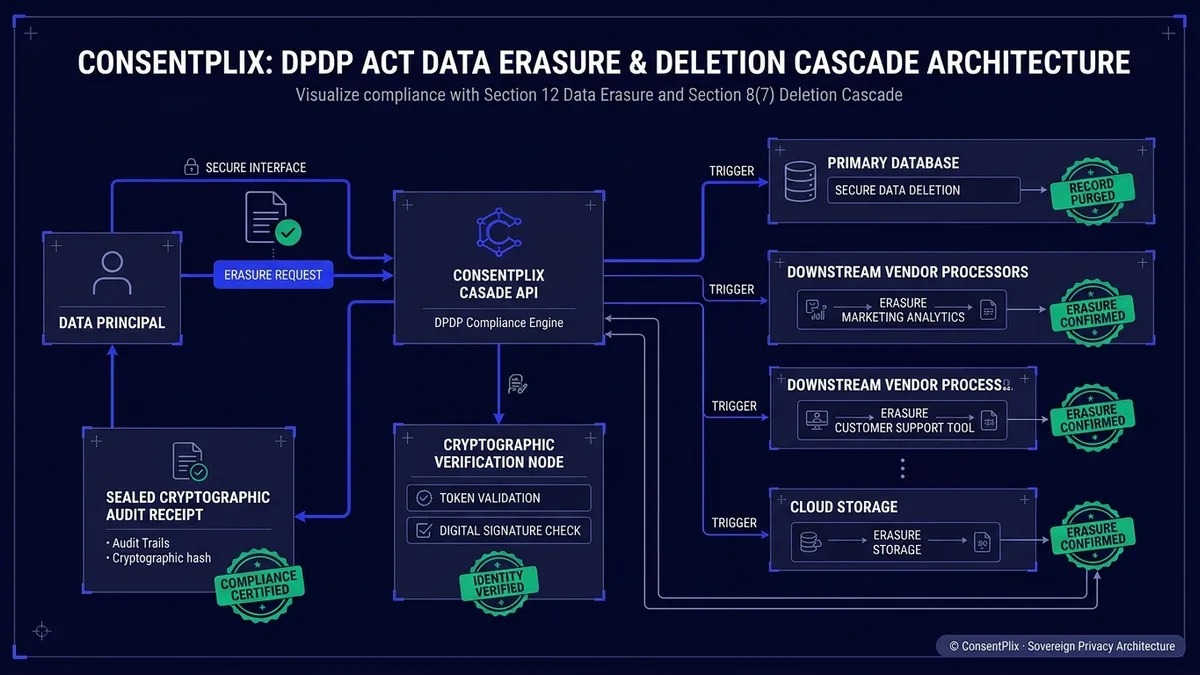
Technical architecture blueprint for implementing DPDP Act 2023 Section 6(4) consent withdrawal across distributed microservices and multi-tenant architectures. Outlines the statutory ease-of-withdrawal mandate, compares synchronous vs asynchronous withdrawal pipelines, and details event-driven pub/sub architectures utilizing Apache Kafka, AWS EventBridge, and cryptographic revocation tokens. Explains how engineering teams automate downstream data unlinking across marketing tools (CleverTap, MoEngage, Klaviyo) and data warehouses while generating immutable HMAC-SHA256 revocation audit receipts.
The Statutory Mandate of Section 6(4)
Section 6(4) of India’s Digital Personal Data Protection (DPDP) Act, 2023 establishes one of the most critical operational requirements for Data Fiduciaries:
“The Data Principal shall have the right to withdraw her consent at any time, with the ease of doing so being comparable to the ease with which such consent was given.”
The statutory benchmark of comparable ease means that if a user granted consent with a single click on an onboarding screen or cookie banner, they cannot be forced to send emails, fill out complex forms, or call customer support to withdraw that consent. Withdrawal must be single-click, instantaneous, and self-serve.
Furthermore, Section 6(4) specifies that the consequences of withdrawal take effect immediately, meaning data processing based on consent must cease as soon as feasible.
For engineering teams operating complex, distributed microservices, handling consent withdrawal in real time presents major architectural hurdles. Here is how to engineer a resilient consent withdrawal pipeline that scales seamlessly.
The Core Challenge: Synchronous vs Event-Driven Revocation
In a modern technology stack, a single user’s personal data does not sit in one centralized database. It is distributed across:
- Authentication Services: User profiles, session tokens, and security flags in PostgreSQL.
- Transactional Engines: Order history, payment metadata, and shipping details in MySQL or DynamoDB.
- Analytics & Product Telemetry: Behavioral events streamed into Snowflake, BigQuery, or ClickHouse.
- Marketing Automation: Customer segments, email lists, and push notification tokens in tools like CleverTap, MoEngage, HubSpot, and Klaviyo.
- Ad-Tech Retargeting: Hashed emails and phone numbers synchronized to Meta Conversions API and Google Customer Match.
Attempting to process consent withdrawal synchronously via HTTP requests across all these systems simultaneously leads to connection timeouts, partial failures, and degraded user experience.
Architectural Pattern: Asynchronous Event-Driven Revocation
To achieve high availability and absolute consistency, custom privacy engineering utilizes an event-driven pub/sub architecture:
+------------------------------------------------------------------------+
|                     USER / DATA PRINCIPAL INTERFACE                    |
|  [Clicks "Withdraw Consent" on /rights or Preference Center]           |
|                                |                                       |
|                                v                                       |
|             [ConsentPlix Ingestion API (AWS ap-south-1)]               |
|            - Issues HMAC-SHA256 Revocation Receipt                     |
|            - Anchors Event to Sovereign Consent Ledger                 |
+--------------------------------|---------------------------------------+
                                 |
                                 v
+------------------------------------------------------------------------+
|                     EVENT STREAMING BUS (Kafka / SQS)                  |
|               Topic: "dpdp.consent.revocation.v1"                      |
|                                |                                       |
|     +--------------------------+--------------------------+            |
|     |                          |                          |            |
|     v                          v                          v            |
|  [Auth Service]         [Marketing Sync]         [Analytics Purge]     |
|  - Invalidate Session   - Unlink CleverTap/      - Mark Pseudonymous   |
|  - Set Gated Flags        MoEngage Tokens          Profiles for Purge  |
+------------------------------------------------------------------------+
1. Cryptographic Ingestion & Local Token Revocation
When the Data Principal toggles off a consent category (e.g., Marketing & Profiling):
- The ConsentPlix client SDK immediately updates the local browser or mobile token storage.
- An HTTPS POST request is dispatched to the ConsentPlix Ingestion API in AWS Mumbai (
ap-south-1). - The server signs an append-only revocation record:
{
  "event_type": "CONSENT_WITHDRAWAL",
  "principal_id": "usr_99a82b314e",
  "withdrawn_purposes": ["marketing_profiling", "third_party_ad_sync"],
  "retained_purposes": ["core_service_delivery"],
  "revocation_timestamp": "2026-10-23T11:42:19.002Z",
  "hmac_signature": "e4a2c19b8f7d3a019485b7c2e6f1a8d3e9c2b4a7d8e1f08f3b219e4a8c17b5e8"
}
2. Decoupled Downstream Propagation
The ingestion service publishes the revocation payload to an internal event bus such as Apache Kafka or AWS EventBridge. Subscribed worker microservices process the revocation independently:
A. Marketing Automation Worker
The marketing consumer immediately calls APIs for CleverTap, MoEngage, or Braze:
- Sets
opt_out_marketing = true. - Flushes the user’s push notification tokens and email subscription status.
- Removes the user’s mobile advertising identifier (IDFA / GAID) from retargeting audiences.
B. Ad-Tech Edge Synchronizer
The edge consumer updates the user’s consent status in Cloudflare KV or Redis cache at the edge. Future HTTP requests originating from this user will immediately fail server-side conversion pixel routing (e.g., Meta CAPI, Google Ads Conversion tracking).
C. Analytical Telemetry Filter
The analytics consumer flags the user’s identifier in the data lake (Snowflake / BigQuery), ensuring that subsequent analytical queries and automated machine learning training sets filter out the user’s historical behavioral records.
3. Statutory Exceptions: Handling In-Progress Transactions
Section 6(4) contains an important statutory qualification:
“The withdrawal of consent shall not affect the legality of processing of personal data based on consent before its withdrawal.”
Furthermore, if the processing is grounded in a statutory retention duty (such as RBI KYC Master Directions or PMLA 2002), the organization is not required to delete records that must be legally retained.
When handling withdrawal:
- Active Orders: If a user withdraws consent during an active e-commerce order or financial transaction, processing required to fulfill the contract proceeds under legitimate grounds.
- Statutory Refusal Certificate: If the user requests full erasure alongside withdrawal, but the account holds active regulatory records, ConsentPlix generates a signed Section 12 refusal certificate detailing the specific statutory conflict.
4. Verification and Audit Dossier Generation
In the event of an investigation by the Data Protection Board of India (DPBI), the Data Fiduciary must prove not only when consent was given, but exactly when and how withdrawal was honored.
By decoupling the revocation pipeline through an immutable ledger, your organization can instantly export an audit dossier showing:
- Exact millisecond timestamp of the user’s withdrawal request.
- The HMAC-SHA256 signature validating the request’s origin.
- Downstream webhook delivery confirmation receipts proving that marketing and ad networks ceased tracking within minutes.
To learn how our engineering team builds custom event-driven revocation pipelines for enterprise architectures, review our Bespoke Privacy Engineering Services or schedule a technical consultation.
Ajay Thanki
Co-Founder & Head of Privacy EngineeringWorks on Merkle audit proofs, tamper-evident data pipelines, and cross-regulation compliance for banking, fintech and enterprise teams.
Continue exploring sovereign compliance engineering.
Ready to deploy provable consent infrastructure?
Deploy in minutes with our sub-12KB SDK or schedule a customized technical consultation with our privacy engineering team.