Implementing DPDP Section 9: Verifiable Parental Consent & Child Data Vaults
How to engineer verifiable parental consent and child data vaults under DPDP Act Section 9. Age verification, guardian token linking, and tracking bans.
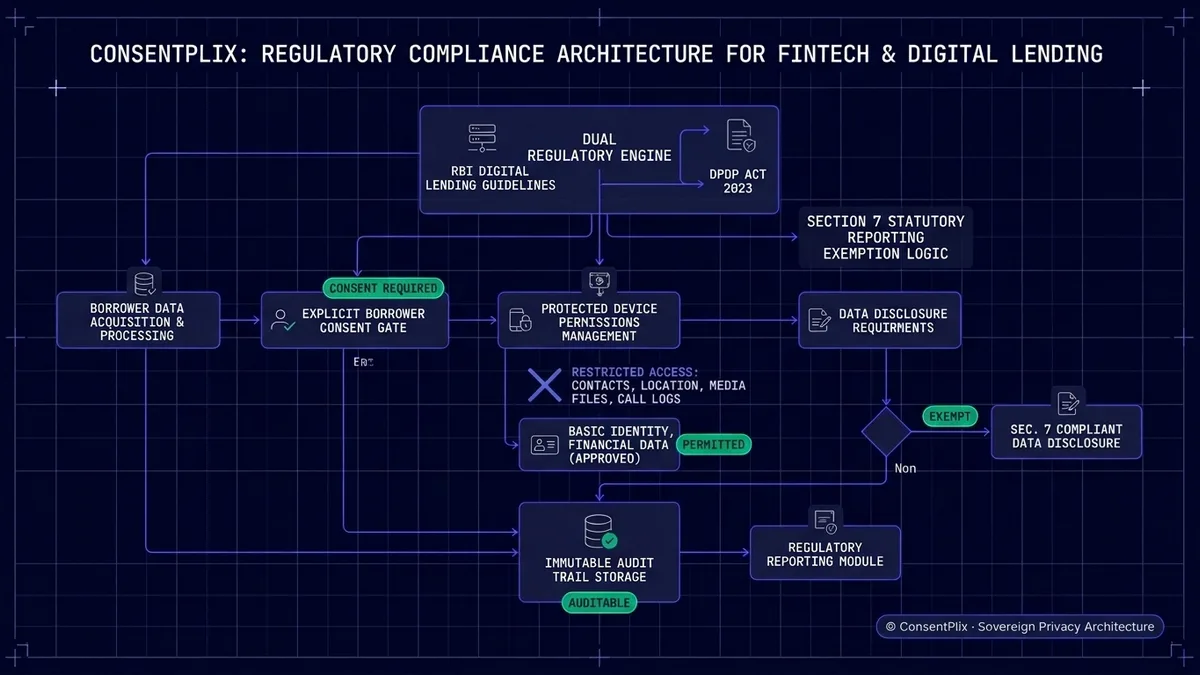
Statutory engineering guide on implementing Section 9 of the DPDP Act 2023 for platforms processing children's personal data. Details the statutory threshold of 18 years, the strict ban on behavioral tracking and targeted advertising directed at children, and the penalty structure reaching up to ₹200 crore under the Schedule for children's data violations. Explains technical architectures for verifiable parental consent (VPC) token bridges, Aadhaar/DigiLocker verification workflows, and isolated minor data vaults.
The High-Stakes Mandate of DPDP Section 9
Among the compliance mandates introduced by India’s Digital Personal Data Protection (DPDP) Act, 2023, few carry greater legal liability than Section 9: Processing of personal data of children.
Unlike the European Union’s GDPR (which permits member states to set the age of digital consent between 13 and 16 years) or the United States COPPA (which applies to children under 13), India’s DPDP Act defines a child as any individual who has not completed 18 years of age.
Under Section 9(1):
“The Data Fiduciary shall, before processing any personal data of a child or a person with disability who has a lawful guardian, obtain verifiable consent of the parent of such child or the lawful guardian, in such manner as may be prescribed.”
Furthermore, Section 9(3) strictly prohibits:
- Behavioral Tracking & Monitoring: Any processing of personal data that is likely to cause any detrimental effect on the well-being of a child.
- Targeted Advertising: Undertaking tracking or behavioral monitoring of children or targeted advertising directed at children.
Under The Schedule of the Act, failure to comply with Section 9 carries statutory penalties capped at ₹200 crore, placing it in the second highest penalty tier behind only security safeguard failures under Section 8(5).
Here is how engineering teams in EdTech, online gaming, social platforms, and e-commerce can architect compliant verifiable parental consent workflows.
1. Age-Gating UX That Preserves Onboarding Conversion
A major challenge product managers face is preventing minors from bypassing age gates without introducing massive onboarding friction that degrades legitimate adult conversion.
The Two-Tier Age Verification Architecture
+------------------------------------------------------------------------+
|                       USER REGISTRATION STEP                           |
|       [User Inputs Date of Birth / Neutral Age Gate Prompt]            |
|                                |                                       |
|        +-----------------------+-----------------------+               |
|        | Age >= 18                                     | Age < 18      |
|        v                                               v               |
|  [Standard Onboarding]                   [Child Safe Mode Activated]   |
|  - Standard Section 6 Notice             - Halt Ad & Analytics Scripts |
|  - Direct User Consent                   - Trigger Parental Flow       |
+--------------------------------------------------------|---------------+
                                                         |
                                                         v
+------------------------------------------------------------------------+
|                VERIFIABLE PARENTAL CONSENT (VPC) BRIDGE                |
|  [Prompt: "Enter Parent / Guardian Mobile Number or Email"]            |
|                                |                                       |
|                                v                                       |
|         [Guardian Verification via Aadhaar OTP / DigiLocker]           |
|                                |                                       |
|        +-----------------------+-----------------------+               |
|        v                                               v               |
|  [Guardian Consent Granted]               [Parent Denies Consent]      |
|  - Generate Parent Auth Token             - Immediate Purge of Minor   |
|  - Provision Isolated Minor Vault           Draft Data Under Sec 8(7)  |
+------------------------------------------------------------------------+- Neutral Age Gates: Do not use pre-selected years or leading questions (e.g., “Are you over 18?”). Require inputting day, month, and year of birth.
- Instant Tracking Circuit Breaker: If the calculated age is under 18, the application must immediately drop all ad network pixels (Meta Pixel, Google AdMob, Unity Ads) and disable user profiling cookies.
2. Implementing Verifiable Parental Consent (VPC) Bridges
Under DPDP Section 9, simple self-attestation (“Check here if your parent allows you”) is legally insufficient. The consent must be verifiable.
Our privacy engineering team deploys three compliant verification mechanisms:
Method A: Government Identity Bridge (DigiLocker / Aadhaar OTP)
For high-risk platforms (edtech, digital content, interactive gaming):
- The platform presents a verification gateway powered by DigiLocker or an Aadhaar authentication service.
- The parent authenticates via Aadhaar OTP, establishing verifiable adult status.
- A cryptographic zero-knowledge proof (ZKP) is returned to the platform confirming the guardian’s age and identity without storing raw Aadhaar numbers, adhering strictly to UIDAI regulations.
Method B: Micro-Transaction & Credit Card Verification
For e-commerce and subscription apps:
- The parent authorizes a nominal ₹1 micro-transaction via credit card, NetBanking, or UPI AutoPay.
- In India, issuance of credit facilities requires KYC under RBI norms, establishing adult status. The nominal authorization fee is instantly refunded.
Method C: Out-of-Band SMS / Email Authentication Token
For low-risk platforms:
- The minor provides the parent’s contact information.
- The platform dispatches a secure, time-bound verification link directly to the parent.
- The parent reviews the Section 5 privacy notice in English or their preferred Eighth Schedule language and authorizes processing via a one-time cryptographic token.
3. Engineering Child Data Vaults & Behavioral Isolation
Once parental consent is verified, engineering teams must enforce the Section 9(3) prohibition on tracking and profiling at the database layer.
Treating children’s records in the same tables and pipelines as adult users inevitably leads to accidental data leakage into marketing automation and analytics clusters.
Architectural Principles for Child Data Vaults:
- Isolated Storage Partition: Personal data belonging to minors must be stored in isolated database schemas or partitioned collections marked with a strict
is_minor = trueflag. - Strict Attribute Whitelisting: Collect only the absolute minimum data required for service delivery (e.g., student name and grade for EdTech learning progress). Prohibit capturing advertising identifiers (IDFA/GAID) or precise GPS coordinates.
- Data Pipeline Exclusion: ETL and stream processing pipelines (Kafka, Snowflake, Databricks) must automatically filter out records tagged with minor flags, preventing inclusion in machine learning recommendation engines or behavioral advertising pools.
4. Cryptographic Proof for Board Inquiries
Under Section 6(10), the burden of proving parental consent rests on the Data Fiduciary. If challenged during an audit by the Data Protection Board of India (DPBI), your organization must produce an audit dossier detailing:
- The parent’s verification method and timestamp.
- The cryptographic receipt signed with HMAC-SHA256 in AWS Mumbai (
ap-south-1). - The specific privacy notice version presented to the parent.
- Proof that behavioral profiling and targeted advertising scripts were locked down.
To learn how ConsentPlix engineers design custom Section 9 parental consent bridges and child data vaults, explore our Bespoke Privacy Engineering Services or schedule a technical consultation.
Ajay Thanki
Co-Founder & Head of Privacy EngineeringWorks on Merkle audit proofs, tamper-evident data pipelines, and cross-regulation compliance for banking, fintech and enterprise teams.
Continue exploring sovereign compliance engineering.
Ready to deploy provable consent infrastructure?
Deploy in minutes with our sub-12KB SDK or schedule a customized technical consultation with our privacy engineering team.