Zero-Leakage Server-Side Tag Gating with Google Consent Mode v2
How to implement zero-leakage ad-tech gating using server-side Google Tag Manager (sGTM) and Google Consent Mode v2 under India's DPDP Act.

Technical architecture tutorial on implementing zero-leakage ad-tech gating using Server-Side Google Tag Manager (sGTM), Cloudflare Edge Workers, and Google Consent Mode v2 for DPDP Act 2023 compliance. Explains the difference between client-side script suppression and edge-level network filtering. Details how to pass ad_storage, analytics_storage, ad_user_data, and ad_personalization signals to preserve conversion modeling while ensuring zero third-party cookie or PII leakage occurs prior to affirmative consent under Section 6(1).
The Failure of Client-Side Tag Gating in Modern Browsers
Traditional consent management platforms (CMPs) rely almost exclusively on client-side JavaScript to block third-party tracking scripts. The CMP injects a script into the document head, monitors DOM node mutations, and attempts to suppress ad pixels (Meta Pixel, Google Ads, TikTok, Pinterest) before they execute.
In practice, client-side tag gating suffers from severe architectural weaknesses:
- Script Race Conditions: Third-party plugins, tag managers, and asynchronous scripts frequently load and fire before the CMP can evaluate user consent tokens.
- Browser Extensions & Ad Blockers: Ad-blocking tools break CMP evaluation loops, causing scripts to fail open or drop telemetry silently.
- Core Web Vitals Penalty: Heavy client-side interception scripts delay First Contentful Paint (FCP) and degrade Interaction to Next Paint (INP).
Under Section 6(1) of India’s DPDP Act 2023, personal data cannot be captured or processed without affirmative, prior consent. If a single pixel transmits an IP address or device identifier to an ad network before user consent, your organization faces statutory non-compliance.
The solution is Server-Side Tag Gating. Here is how to architect an edge-gated pipeline using Server-Side Google Tag Manager (sGTM) and Google Consent Mode v2.
Architecture: Edge-Level Network Filtering
In a server-side tag gating architecture, client browsers do not send tracking events directly to third-party ad networks. Instead, all browser pings are routed through a first-party proxy endpoint running on your domain (e.g., metrics.yourdomain.com).
+------------------------------------------------------------------------+
|                     CLIENT BROWSER (First-Party Domain)                |
|  [Pageview / Purchase Event] ---> [ConsentPlix Light SDK (<12KB)]      |
|  - Reads Consent Mode Signals:                                         |
|    ad_storage, analytics_storage, ad_user_data, ad_personalization     |
+-----------------------------------|------------------------------------+
                                    |
            HTTP POST to: metrics.yourdomain.com/collect
            Payload includes: Client ID + Consent State Header
                                    |
                                    v
+------------------------------------------------------------------------+
|               EDGE WORKER / sGTM CONTAINER (AWS Mumbai)                |
|  [Inspects Consent State Signals in HTTP Payload]                      |
|                                   |                                    |
|         +-------------------------+-------------------------+          |
|         | Consent = 'granted'                               | 'denied' |
|         v                                                   v          |
|  [Dispatch Full Telemetry]                      [Strip Cookies & IP]   |
|  - Meta Conversions API (CAPI)                  - Send Cookieless      |
|  - Google Ads Enhanced Conversions                Conversion Ping      |
+------------------------------------------------------------------------+
Configuring Google Consent Mode v2 Signals
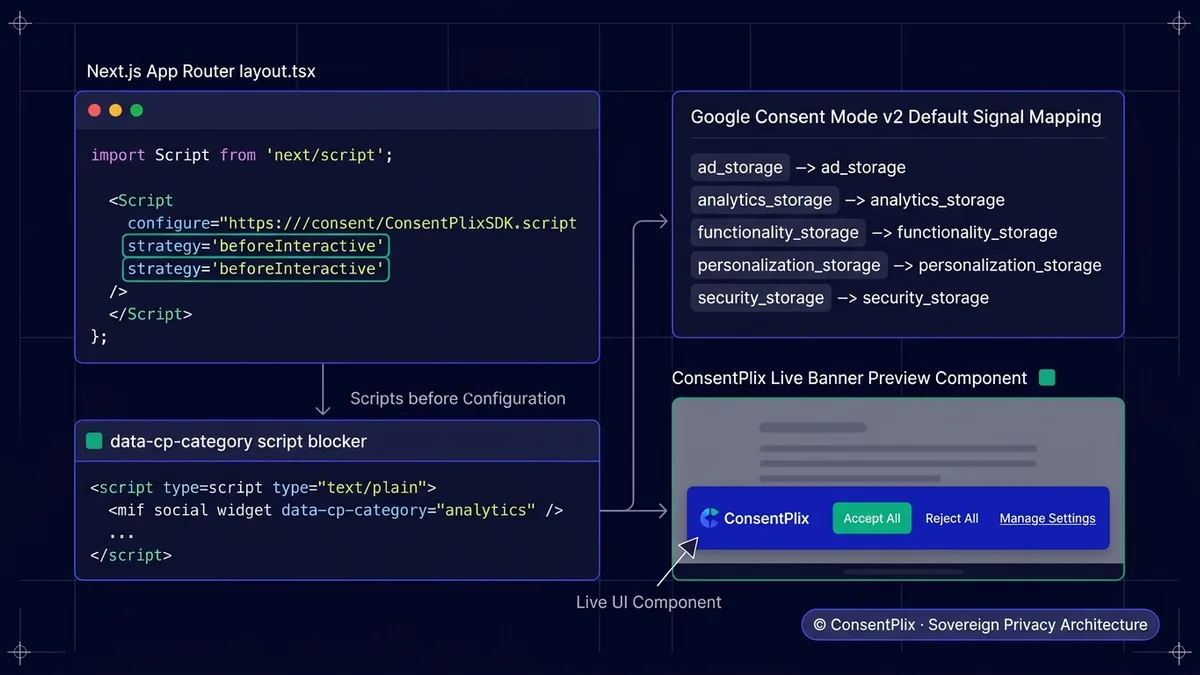
Google Consent Mode v2 introduces four essential statutory consent parameters:
ad_storage: Permissions for ad-related cookies and identifiers.analytics_storage: Permissions for analytics telemetry and usage statistics.ad_user_data: Permissions to send user personal data (email, phone) to Google for advertising purposes.ad_personalization: Permissions for remarketing and targeted personalized ads.
1. Default State Initialization in HTML Head
Before any tracking scripts or tag manager containers load, you must initialize the consent default states to denied. This ensures zero telemetry transmits until affirmative consent is confirmed:
<script>
  window.dataLayer = window.dataLayer || [];
  function gtag(){dataLayer.push(arguments);}

  // Establish default denied state under DPDP Section 6(1)
  gtag('consent', 'default', {
    'ad_storage': 'denied',
    'analytics_storage': 'denied',
    'ad_user_data': 'denied',
    'ad_personalization': 'denied',
    'wait_for_update': 500
  });

  gtag('set', 'ads_data_redaction', true);
</script>

<!-- Load ConsentPlix High-Performance SDK (<12KB) -->
<script async src="https://cdn.consentplix.com/sdk/v1/consentplix.min.js"></script>
2. Server-Side Payload Inspection in sGTM
When the user accepts specific purposes on the ConsentPlix notice dialog, our client SDK fires an immediate gtag('consent', 'update') call:
// Triggered on user affirmative consent
gtag('consent', 'update', {
  'ad_storage': 'granted',
  'analytics_storage': 'granted',
  'ad_user_data': 'granted',
  'ad_personalization': 'granted'
});
The browser dispatches the event payload to your server-side GTM container running on AWS ap-south-1 (Mumbai). The sGTM container evaluates the incoming consent parameters before routing:
-
When Consent is Granted:
- The sGTM container unpacks the event and forwards complete server-to-server payloads to the Meta Conversions API (CAPI), Google Ads API, and Google Analytics 4.
- First-party user identifiers are included, ensuring 100% conversion tracking accuracy.
-
When Consent is Denied:
- The sGTM container automatically strips all cookies, IP addresses, user agent headers, and click IDs (
gclid,fbclid). - A cookieless behavioral ping is forwarded to Google Analytics, allowing aggregate conversion modeling without capturing or storing personal data.
- Meta CAPI and external retargeting networks receive zero data, maintaining complete statutory compliance.
- The sGTM container automatically strips all cookies, IP addresses, user agent headers, and click IDs (
3. Preserving Marketing ROI While Maintaining Compliance
The primary fear marketing teams express regarding privacy compliance is the loss of conversion tracking and ad attribution accuracy.
By implementing server-side tag gating with Google Consent Mode v2:
- Zero Script Leaks: Trackers cannot fire client-side without edge-level validation.
- Conversion Modeling Unlocked: Google’s machine learning models recover up to 70% of lost conversion data using anonymized pings, preventing ad campaign performance degradation.
- Improved Page Speed: Moving tag execution from the client browser to the sGTM cloud container reduces browser JavaScript execution time by up to 300ms, directly boosting Core Web Vitals and search rankings.
Next Steps: Deploying Server-Side Gating for Your Stack
Implementing server-side tag gating requires careful orchestration of DNS records, sGTM container templates, and edge worker logic.
To learn how ConsentPlix engineers design and deploy custom server-side tag gating for enterprise brands, explore our Bespoke Privacy Engineering Services or schedule a technical scoping call today.
Amjad Rathod
Co-Founder & Chief ArchitectLead architect of the ConsentPlix consent ledger and sub-12KB client SDK. Works on DPDP Section 6 consent flows and high-throughput privacy engineering.
Continue exploring sovereign compliance engineering.
Ready to deploy provable consent infrastructure?
Deploy in minutes with our sub-12KB SDK or schedule a customized technical consultation with our privacy engineering team.